

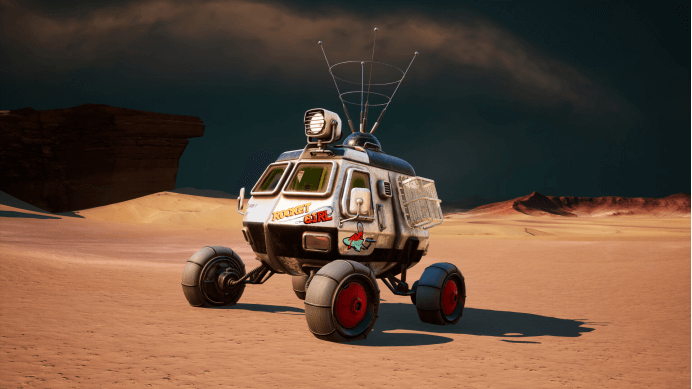
When I first drove the probe through the sea of silicon sand of the Regis III star and watched those strange structures like metal plants sway slowly in the hot wind, I suddenly realized that I was not stepping into an alien world, but a huge philosophical experimental field. The Invincible, a hardcore science fiction work from Poland, turns the universe full of cognitive crisis written by Stanislaw Lem into a maze of thought that players can walk in person.
The game opens with a complete communication interruption. The astronaut I played, Yasna, woke up from the dormant capsule and found that the exploration ship “The Dragonfly” was quietly floating in the orbit of Regis III, and the surface camp had been lost for 72 hours. But what really sets the tone of the game is not the common survival crisis, but the Lyme-style “cognitive dilemma” — each of my tools is working normally, but it is telling contradictory stories: the mass spectrometer shows that the atmosphere is full of organic molecules, but telescopes can’t see any signs of life; radiation detectors are calm as usual. But all electronic devices are recording inexplicable interference waveforms. This sense of rupture between scientific instruments and perceived reality makes the simplest movement become a philosophical choice.
The most exquisite design lies in the “reasoning system” of the game. Yasna is not equipped with a universal scanner, but a set of simulation scientific tools that require manual operation: the tape recorder requires manual rewinding to replay key sections, the holographic map must be marked with a light pen to record hypotheses, and even the focal length of the microscope needs to be manually adjusted. In the chapter “The Silent Canyon”, I spent forty minutes in reality comparing rock sample data from three different times, and finally derived not the answer, but three more profound questions. This design that gamifies the “research process” itself completely subverts the common practice of “pressing the F key to get the truth” in science fiction games.
With the in-depth investigation, the game shows the core proposition of the Lyme universe: the limitations of human cognition. Those structures, which were originally marked as “alien mechanical”, were later discovered that they may be the metabolic by-products of some silicon-based life; and the repeated “hostile behavior” in the camp log showed that it may be a non-targeted chemical reaction triggered by human probes after cross-verification. In the “The Quantum Cloud” encounter, the choice I face is not “fighting or running away”, but “which theoretical framework to use to explain the phenomenon”: choose the Von Neumann probe hypothesis, and the game will enter the technical analysis route; choose the collective The wisdom hypothesis opens the philosophical dialogue tree of consciousness; and the choice of “Phenomenological Epoché” — that is, admitting that it is temporarily incomprehensible — will unlock the most amazing discovery. This respect for the “right to ignorance” is a revolution in contemporary games.
The game’s application of retro futuristic aesthetics is intoxicating. All equipment adopts the science fiction design of the Cold War in the 1960s: the console is a warm wooden panel with metal buttons, the display is flashing with green vector graphics, and even the space suit has the clumsiness of the early space race. This design is not only a style choice, but also a narrative tool — it reminds players that we are facing an existence that may surpass the understanding of all times from the technical perspective half a century ago. In the chapter “The Midnight Sun”, I found orbital abnormalities through the old-fashioned rangefinder, and this discovery itself tells that sometimes the low-tech perspective can see the truth filtered out by high-tech equipment.
Late at night after customs clearance, I opened Lime’s _Solaris_. The greatest achievement of _The Invincible_ is that it does not try to “gamify” Lyme’s idea, but creates an interactive space for players to experience Lyme’s dilemma. In this world, the most important skills are not shooting or building, but staying suspicious, enduring uncertainty, and daring to say “I don’t know” when the data is insufficient. If you are tired of superhero-style space opera, this work will give you the most rigorous interstellar contemplation — after all, in the depths of the real universe, the biggest threat may not be monsters, but our overestimation of our ability to understand ourselves.