

My first “work” was a rough crayon painting. In the center of the picture, there is a curled shadow hidden under a twisted water tower, and the title is written in scarlet font: “They come from the pipe”. I pinned it on the community bulletin board, next to the water bill notice and the second-hand sale advertisement. Three days later, I went back there and found that someone had added more shadows in the corner with a pencil, and another person wrote in trembling handwriting: “I have seen it.” At that moment, I felt a chill in my back, not because my fear came true, but because I realized that I had just ignited the first uneasy flame.
_The Fabulous Fear Machine_ was handed over to me, not firearms or magic, but a set of beautifully designed retro typesetting tools and a blank city model. My task is not to fight monsters, but to become a monster — or to become the creator of monsters. The core of the game is cards, but each card is not a sword or a spell, but a “seed of fear”: a vague eyewitness report, a tampered data chart, and a suggestive nursery rhyme. I need to choose which seed to plant in which social soil. Working-class communities are more likely to believe in “the machinery that steals work”? Are the rich suburbs more sensitive to the “sub-sound waves that pollute the soul”? This is not a simple numerical matching, but a cold social and psychological experiment.
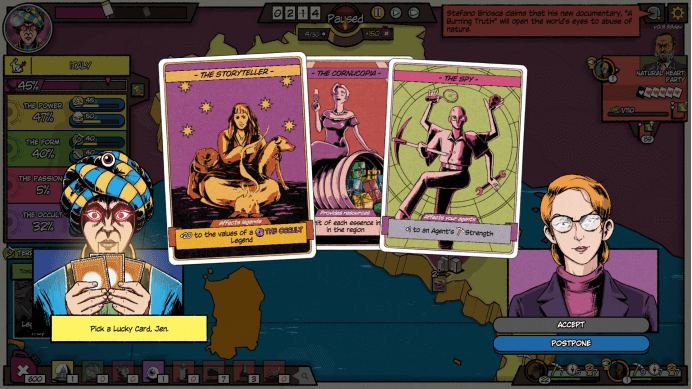
What fascinates me most is the “aesthetic system” of the game. All the fears I spread will be presented in the style of propaganda posters in the mid-twentieth century. Thick lines, high contrast color, suggestive symbols — a dripping mucus horn represents “the broadcast of controlling thoughts”, and a pair of hands extending from the sewer represents the “underground lurker”. This kind of aesthetics is not only a style, but also a part of the narrative itself. Those retro visual languages, with a certain authoritative and unquestionable texture, make absurd stories put on a credible coat. I saw the poster I designed appear on the street corner of the virtual city, and the pixel residents stopped to watch, and small bubbles of doubt appeared above their heads. Fear has become a commodity that can be typeset, printed and widely distributed.
As my “fear network” spread out layer by layer, the city began to breathe by itself — or rather, it spasm by itself. The rumors about “thieves at night” that I originally spread turned into a city-wide “curfew petition” after experiencing bar gossip, tabloid reprints and neighborhood watch meetings. I didn’t directly promote this result. I just provided the original story framework. It was the city’s suspicion and anxiety that completed the subsequent creation by itself. The game shows its sharpest insight here: the real fear machine is never an evil individual, but the information circulation system of society itself. We just threw a grain of sand into the gear, and the machine itself ground it into dust that destroyed itself.
Later in the game, when I was able to control three contradictory horror narratives at the same time (let the East District fear technology, the West District fear tradition, and the city center doubt each other) and draw “influence” fuel from them, a huge sense of nothingness swallowed me. There is no ecstasy of victory, only the fatigue of watching a city tremble in countless self-made ghosts. I turned off the switch of the spread of fear, but the city did not calm down immediately. Rumors have their own life. After my screen is turned off, they are still whispering in the data souls of those pixel villains for a long time.
On the night of customs clearance, I browsed social media and suddenly had a strange alert to those rapidly spreading fragments, those emotional plots, and those seemingly authoritative brief conclusions. What The Fabulous Fear Machine gave me was not a technique to manipulate public opinion, but a pair of glasses that could never be taken off again. Through it, I see how many “seeds of fear” are carefully designed or unintentionally released floating in the ocean of information we are immersed in every day. It reminds me that perhaps the most terrible monster has never been the hands in the sewer painted on the propaganda poster, but the irresistible desire for dark stories that we are so willing to believe in the existence of those “hands” deep in human hearts. After all, it is never the lack of truth that feeds all urban legends, but the seed called “What if” that we throw together.