

When my boat lost its way in the fog for the first time, the compass needle just circled lazily. On the chart in front of you, the ink marks are not treasures or monsters, but the names of seven scattered islands, with notes of different handwriting next to each name — some say “lack of doctors and medicine”, and some say “distrust outsiders”. At that moment, I suddenly realized that this voyage was not looking for a certain place, but to reconnect a broken world.
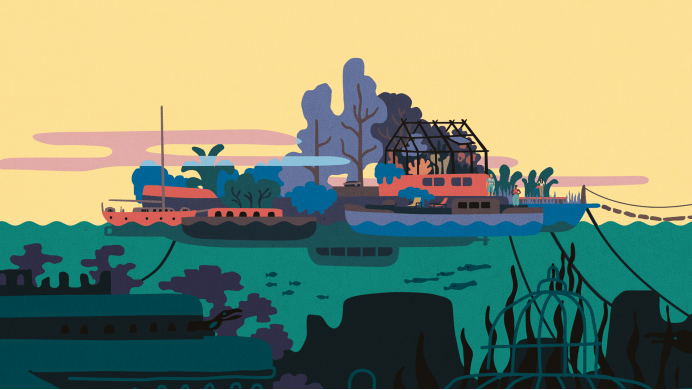
The story of _Saltsea Chronicles_ begins after a great flood. I was not driving a powerful warship, but an old ship that had been barely repaired. The members were a group of strangers who were separated by the flood and reunited by fate. Our fuel is not gold coins, but stories. Every time you reach an island, the game will not pop up the task list, but present a web of character relationships, unsolved knots and potential choices. On the “Rust Chain Island”, I spent a whole evening sitting by the dock and listening to the two old men talking about the same conflict in completely different versions. My choice is not to judge who is right and who is wrong, but to decide whose olive branch to bring to the resentful patriarch of the next island.
What fascinates me most is the way the game handles “dialogue”. It doesn’t give us the options of “persuading”, “deceiving” or “inquiring”. Every word is like a stone thrown into the sea, and the ripples will spread to your unexpected shore. I remember that in the “Echo Islands”, in order to reconcile two families arguing for fishing rights, I chose to help a family teenager repair his damaged song recorder first. This seemingly unrelated move to the main line made him sing an ancient ballad about tolerance for me at the later community meeting. At that moment, the deadlock was melted by a song. The game silently tells me that politics is not a chip on the negotiating table, but a tide of countless subtle kindness and understanding.
Sailing itself is also a narrative. When the storm comes, all the crew will gather in the cabin. Someone checks the map, someone reinforces the goods, and what players need to do is to talk to each of them — not to give orders, but to listen to their fears, memories or a simple encouragement. A successful voyage may depend on whether you remember that the old injury of the first man will hurt in wet weather, and arrange a more relaxed rotation in advance. Here, leadership has nothing to do with majesty, but whether you can maintain the subtle temperature of this floating home.
When I finally arrived at the last island and saw the messengers of the islands — those who had been closed by separation and trauma — sitting together to share seeds and scores because of our voyage, the slogan “The world has been saved” did not pop up on the screen. In the sunset, my captain gently wrote a line in the logbook: “Sea salt may be bitter, but it can keep the food fresh and make the wound sober. This sea is no longer a barrier. It has become our common memory, salty and necessary.”
Long after closing the game, I looked out the quiet night outside the window. _Saltsea Chronicles_ left me not the sense of accomplishment of passing the customs, but a strange comfort. It makes me believe that in a world destroyed by floods, the way to rebuild civilization is not to wave flags or build high walls, but to set sail patiently and again and again, and carry each other’s stories, like the most precious fresh water and seeds, from one isolated island to another. After all, when the last piece of land sinks, what we can hold on to is the hands of the people around us and the stories that have not been washed away by the sea.