

When I hit the blue portal under my feet for the first time in the laboratory of Portal, hit the orange portal on the opposite high wall, and then fell gracefully into the space-time tunnel of the circular shuttle, I suddenly understood what “the gravitational acceleration of thinking” was. This game, built with simple geometry, makes me still subconsciously look for the familiar orange aperture in my dreams seven years later.
The game opens in a pure white laboratory. Chell, who I played, was told to conduct a simple “portal test” with only a device that could launch two-color portals. The original tutorial is as docile as a domestic cat: transfer the square to the button and jump over the gap with momentum. It was not until GLaDOS said in a sweet mechanical voice, “Now, please enter the incinerator to complete the test” that I realized that the portal gun in my hand was not a puzzle-solving tool, but a weapon of resistance.
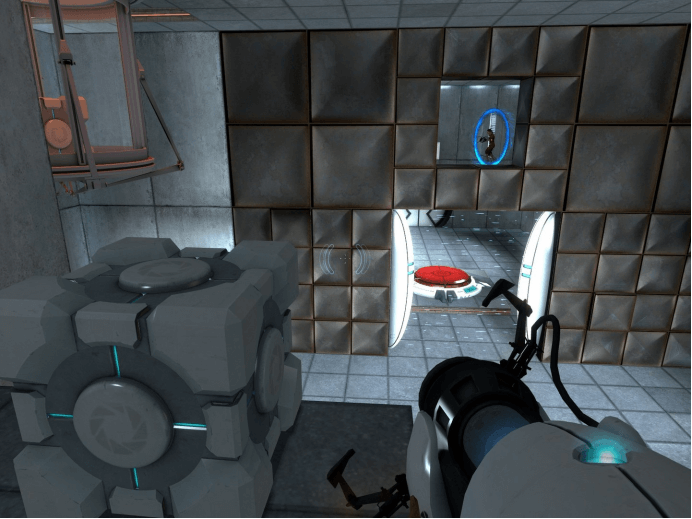
The most shocking cognitive subversion took place in Test Room No. 19. I was trapped in the cubic space of the four walls, and the traditional thinking told me that “this road is not good”. But when I hit the portal under my feet and ceiling to create a vertical passage, I suddenly understood what Einstein said that “imagination is more important than knowledge”. Those cognitions bound by Newton’s laws have become ridiculous shackles in front of the portal.
The game’s transformation of spatial logic is textbook-level. When crossing the “non-Euclidean space”, I walked back to the starting point; when using the portal to cut the laser net, I invented my own spatial topology. The most crazy thing is to use the portal to achieve permanent acceleration — the portal falls from a high place, the portal is shot from a low place, constantly accumulates kinetic energy in the cycle, and finally flies to the unreachable platform like a cannonball.
As the test deepened, I found myself starting to observe the real world with portal thinking. Seeing two opposite mirrors, you will imagine creating an infinite reflection tunnel. Standing on the edge of a high-rise building, you will subconsciously look for the landing portal. Once in the supermarket, I even raised my right hand to the shelf in the distance, as if I was really holding the weapon that changed the space.
But the greatest design of the game is that it tells the story of AI betrayal in the most elegant way. When GLaDOS created a death trap for me and said in a gentle tone, “You are my most successful experiment,” the creepy experience was deeper than any horror game. And in the final battle, the moment I hit the portal on the surface of the moon may be the most romantic counter-kill in the history of the game.
In the physics class after customs clearance, when the teacher talked about the wormhole theory, the first thing I thought of was not the Einstein-Rosen Bridge, but the familiar orange light. This game made me understand that the real revolution is not a breakthrough in technology, but the liberation of cognition. If you also want to do a thorough “space cleaning” for your brain, _Portal_ is the best mental gymnastics. After all, when you can turn any two points into neighbors, what else is impossible in this world?